Foot Health Guides
What to record in a foot-pain diary before an appointment
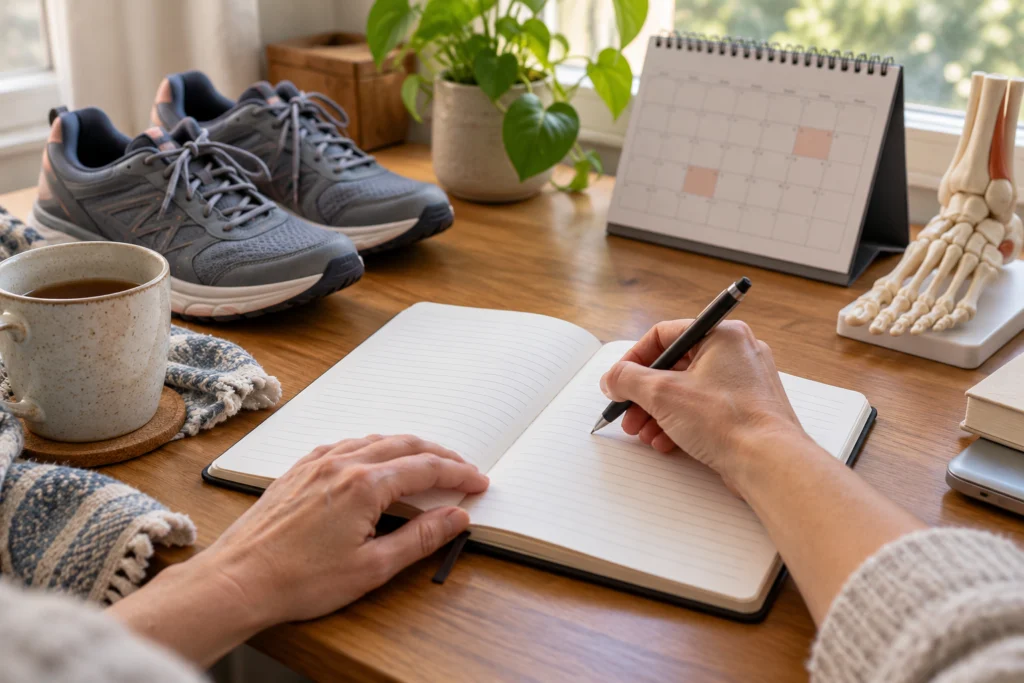
A useful pain diary is short enough to maintain and specific enough to discuss. Its purpose is to describe an ordinary pattern before an appointment, not to prove that a particular shoe or activity caused the problem. A few clear entries are often easier to review than pages of unexplained numbers.
Record context alongside the symptom
Use the same simple format each day. Note the activity, approximate duration, footwear and the location of discomfort. If you use a pain scale, keep its meaning consistent for yourself and add what the symptom prevented you from doing.
Include changes after the activity and at the next relevant point, such as the following morning. Do not repeat a painful task simply to fill a row. A diary should not interfere with advice you have already received.
| Field | Example of useful detail | Avoid |
|---|---|---|
| Activity | Walk to the bus and wait standing | Only writing “busy day” |
| Footwear | Usual work shoes with prescribed insert | Assuming the shoe is the diagnosis |
| Response | Stopped early because of heel discomfort | A number without context |
| Change | Different task or symptom since yesterday | Rewriting older entries from memory |
Keep interpretation separate
Write observations in one column and questions in another. “Pain after the commute” is an observation; “the pavement damaged my fascia” is an explanation that the diary cannot establish. This separation makes the record more useful during assessment.
Mention relevant changes in work, exercise, shoes or health. If several things changed together, record that rather than crediting or blaming one. A good diary can show uncertainty honestly.
- Choose a brief format you can complete in a minute or two.
- Record the activity pattern without deliberately provoking symptoms.
- Include the footwear and any clinician-advised aids used that day.
- Bring the diary and your main questions to the appointment.
Do not let record-keeping postpone care
Severe, worsening or recurrent pain, loss of feeling and foot pain with diabetes need professional attention. A diary can support that conversation but should not become a reason to wait until you have a “perfect” record.
At the visit, ask which entries are useful and whether continued tracking is needed. If the plan changes, record the new advice and review date so later notes have a clear reference point.
Questions and answers
Do I need a special app?
No. Paper or a simple note can work. Choose a format you can maintain and share without exposing private information unnecessarily.
Should I score pain every hour?
Not unless a clinician asks for that level of detail. Repeated checking can become burdensome; a few consistent context-rich entries may be more useful.
Can the diary tell me which treatment works?
It may help describe changes, but it cannot by itself establish cause or effectiveness. Discuss the pattern and any simultaneous changes with your clinician.
Sources: nhs.uk.