Foot Health Guides
Insoles and orthotics: Questions to ask before a purchase
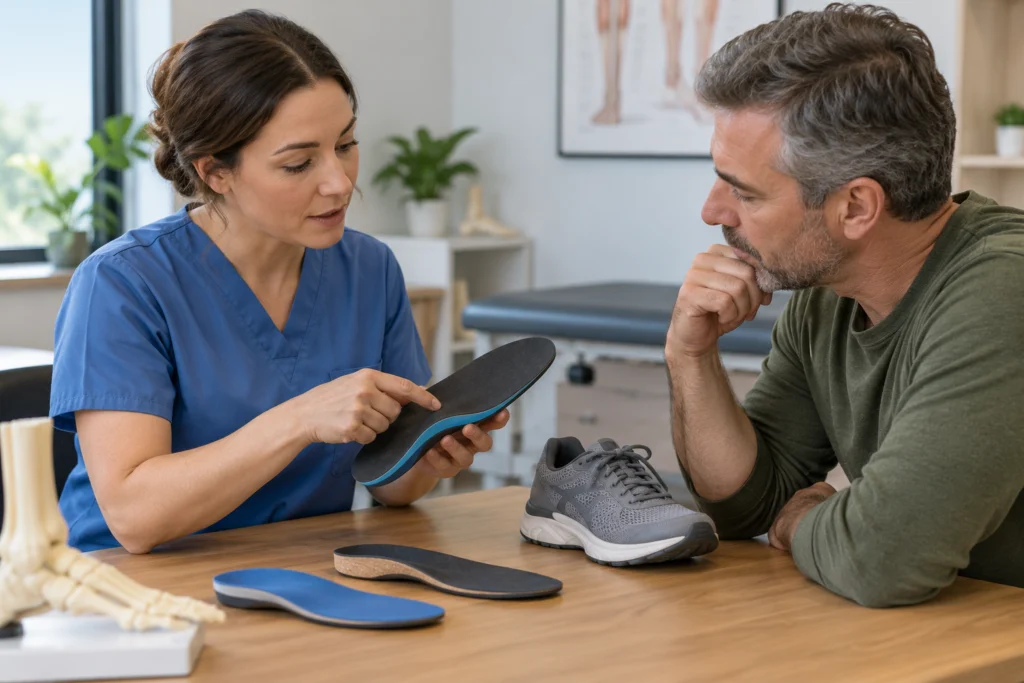
Insoles and orthotics are often marketed together, but the proposed product and the reason for using it should be clear. Before buying, ask what problem it is meant to address, how it fits your existing footwear and how its effect will be reviewed. Price alone cannot establish whether an option is appropriate.
Understand the recommendation
Ask the recommending professional to explain the assessment behind the suggestion. Clarify whether you are considering an off-the-shelf insert, an adjusted product or a custom-made device. The name is less useful than knowing the purpose and the process.
Bring the shoes you wear most often. An insert changes the space available inside a shoe and may affect pressure or heel hold. Do not assume that a device which fits one pair will work equally well in every shoe.
| Area | Ask this | Record |
|---|---|---|
| Purpose | What specific need is this intended to address? | The explanation and alternatives |
| Fit | Which shoes and socks should I use? | Compatible footwear |
| Use | How should I start and what problems should I report? | Individual instructions |
| Review | When will fit and response be checked? | Review date, costs and contact route |
Compare the whole service
Find out whether fitting, adjustment and follow-up are included. Ask about returns or changes if the product cannot be used as intended. A low purchase price can be misleading if necessary follow-up is not available; a high price is not a guarantee of benefit.
Do not layer several inserts without advice. Extra thickness can change fit and create new pressure. If you have altered sensation, diabetes or another condition affecting foot care, discuss those factors before experimenting.
- Ask for a plain-language reason for the proposed device.
- Bring the actual shoes and existing inserts to the fitting.
- Request written use and review instructions.
- Keep a short note of new pressure or discomfort rather than forcing continued use.
Keep expectations realistic
A device may form one part of a management plan. It should not be sold as proof that a particular diagnosis has been established or as a universal solution for every painful foot. Ask what would lead the clinician to revise the plan.
If symptoms are severe, worsening or recurrent, seek assessment rather than simply purchasing another insert. A repeated buying cycle can delay understanding the problem and make it difficult to know which changes matter.
Questions and answers
Are custom-made devices always necessary?
Not for every person or situation. An appropriate professional should explain why a particular option is being recommended and what alternatives exist.
Can I move an insert between all my shoes?
Only if the fit and instructions allow it. Shoe shape and available space differ; check pressure and heel hold rather than assuming compatibility.
Should I keep using a painful device until I adapt?
Follow the individual fitting advice and report new or worsening discomfort. Do not assume significant pain is an obligatory part of using an insert.
Sources: nhs.uk.